Technical Architecture
Infrastructure Architecture Overview
The AWS environment provides a dedicated VPC in the London region with public and private subnets, isolating the application and database tiers for security and performance.
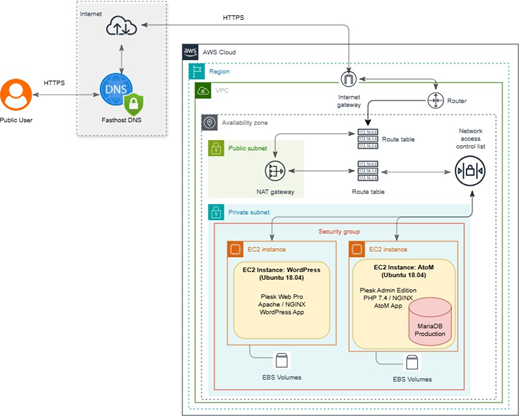
A major infantry regiment of the British Army migrated its critical digital archive platform — built on Plesk, AtoM, and WordPress — from a shared hosting provider to a secure, dedicated Amazon Web Services infrastructure, with zero data loss and no unplanned downtime.
A major infantry regiment of the British Army's digital archive platform is a critical repository of regimental history. To ensure long-term security and availability of these assets, the decision was made to migrate from a shared provider to dedicated AWS infrastructure — improving resilience and performance without the risks of changing operating systems or redesigning software.
The customer's digital archive is built on two core applications — AtoM for archival search and WordPress for the regimental website — both managed via the Plesk control panel on Ubuntu Linux.
| Server | Purpose | Location / Cloud | Instance Type | OS | Control Panel | Applications |
|---|---|---|---|---|---|---|
| Main Application Server | Web Applications | AWS EC2 London | t3.large | Ubuntu 18.04.6 LTS | Plesk Obsidian 18.0.52 (Web Pro) | WordPress |
| Atom Server | Archival System | AWS EC2 London | t3.large | Ubuntu 18.04.6 LTS | Plesk Obsidian 18.0.73 (Web Admin) | AtoM, PHP 7.4 |
| Component | Details |
|---|---|
| Domain & DNS | Fasthost (Shared hosting — domains only) |
| Cloud Provider | Amazon Web Services (AWS) |
| Compute | EC2 Instances (2 Servers) |
| Operating System | Ubuntu 18.04.6 LTS |
| Web Stack | Apache + NGINX Reverse Proxy |
| PHP Version | PHP 7.4.33 |
| Database Engine | MariaDB 5.5.68 & MariaDB 10.4.30 |
| SSL | Let's Encrypt (Auto Renew, Partial Wildcard) |
| Backups | Local Plesk Backups → AWS Automated Snapshots |
The project focused on the seamless transition of the entire digital ecosystem, ensuring that "business as usual" was maintained throughout. All key application and database components were migrated for end-to-end functionality.
The core archival database and public-facing search portal, providing public access to the regiment's historical records and digital collections. Migrated with complete data integrity intact.
The primary regimental website and content management system. All content, media files, theme configurations, and plugins were transferred without alteration to the new dedicated AWS environment.
The existing management interface used by administrators to maintain data integrity. All files, historical records, and databases were moved without alteration, preserving the familiar admin experience.
The AWS environment provides a dedicated VPC in the London region with public and private subnets, isolating the application and database tiers for security and performance.
The migration was executed using a structured, phased approach to ensure minimal risk and downtime — with strong customer involvement at every stage and formal sign-off before production cutover.
The existing environment was comprehensively assessed to understand infrastructure, applications, data, and constraints. Migration feasibility was confirmed, risks were identified, and an AWS-based target architecture was designed and formally approved before any migration work began.
A full sandbox environment was deployed in AWS to validate the architecture before any production data was touched. Applications and data were rigorously tested for functionality, performance, and security in the new environment, followed by formal customer review and sign-off.
The production environment was provisioned based on the validated design from the sandbox phase. Final testing was completed in the live environment, and a planned cutover was executed with DNS updates — achieving zero unplanned downtime during the transition.
Post go-live monitoring, backup configuration, and operational handover were completed to ensure long-term stability and reliability. The team ensured the customer's staff were fully confident managing the new environment before closing the engagement.
A core requirement of this project was to maintain the existing application functionality intact. To minimize operational risk, the following critical elements remained completely unchanged throughout the migration.
Ubuntu 18.04.6 LTS was retained on both EC2 instances to ensure full application compatibility with AtoM and WordPress, eliminating OS migration risks entirely.
No changes were made to the AtoM or WordPress code. The applications run in the new environment exactly as they did in the shared hosting setup — no rewrites, no patches.
The management experience via Plesk remains identical for administrators. Staff log into the exact same dashboard interface with no workflow changes or retraining required.
Data remains in its native, proven MariaDB format. No schema changes, no data transformations — the complete database structure migrated as-is with full integrity verification.
While the applications remain the same, the foundation they sit on has been significantly upgraded. Migrating from shared hosting to AWS provides five core infrastructure advantages that directly benefit the long-term viability of the archive.
The platform no longer competes for CPU or memory with other organisations on the same server, leading to consistently faster page load times and higher system stability — critical for public-facing archival access.
AWS provides Infrastructure Snapshot technologies, allowing for a full-server recovery in minutes should a critical error occur — replacing the previous manual Plesk backup approach with automated, enterprise-grade protection.
The environment is now protected by AWS-grade firewalls, IAM access controls, and completely isolated networking — eliminating exposure to vulnerabilities from shared tenants on legacy hosting infrastructure.
As the regiment's digital collections grow over the coming years and decades, the AWS server can be expanded instantly without requiring another disruptive migration — a fundamental advantage for a long-term archive.
A dedicated hosted environment secures applications and databases from third-party vulnerabilities. Security compliance including GDPR and data governance requirements are fully satisfied by the dedicated AWS hosting model.
The customer gained flexibility in managing costs with full visibility into infrastructure usage, enabling optimization over time. The pay-as-you-scale model replaces the fixed costs and hidden limitations of shared hosting plans.
A direct comparison of capabilities across every dimension shows the step-change improvement delivered by migrating to dedicated AWS infrastructure.
| Feature | ❌ Legacy Shared Hosting | ✅ New AWS Environment |
|---|---|---|
| Server Model | Shared with other organisations | Dedicated to the customer, enhancing security compliance |
| Performance | Variable — dependent on other tenants | Consistent & high speed at all times |
| Backups | Manual / Local (Plesk only) | Automated AWS Snapshots — full server recovery in minutes |
| Control | Limited by the hosting provider | Full administrative control over all infrastructure |
| Reliability | Basic — shared infrastructure SLA | Enterprise-grade AWS SLA and availability |
| Scalability | Fixed resources, limited ability to scale with traffic growth | Elastic, on-demand scaling to handle peak and future workloads |
| Security | Basic, shared security controls with limited customization | Enterprise-grade security with encryption, IAM, and network isolation |
The inclusion of the Plesk Control Panel within the migration ensures that customer internal teams require no new training and experience zero disruption to their established workflows.
Routine updates and file management continue through proven Plesk workflows. No new tools, no new processes — administrators work exactly as before with improved infrastructure underneath.
Users log into the same Plesk dashboard they are accustomed to. The management experience is identical, ensuring zero learning curve and immediate productivity from day one post-migration.
SSL certificates via Let's Encrypt are managed and renewed automatically in the new environment, eliminating manual certificate management and ensuring continuous HTTPS protection for all users.
The migration to AWS transitions the archive to a professional-tier service model, providing the foundations for sustainable, cost-effective, and future-ready operations for decades to come.
Dedicated infrastructure reduces the likelihood of downtime-related costs. With guaranteed resources on AWS, the archive delivers consistent response times regardless of what other workloads exist elsewhere on the platform.
The setup allows for clear monitoring of server health, performance metrics, and security patching through AWS CloudWatch and Plesk dashboards — providing full visibility that shared hosting could never offer.
By moving to the cloud leader (AWS), the customer is no longer tied to the limitations of a specific regional hosting provider. The archive can grow, scale, and evolve with AWS's expanding global service catalogue.
The customer gained flexibility in managing costs with full visibility into infrastructure usage. This enables ongoing optimization over time, helping the regiment save money and make efficient use of their hosted infrastructure.
The migration delivers measurable return across six distinct value dimensions — from eliminating security risks to enabling faster system improvements and ensuring the archive remains always accessible.
The migration of the customer's digital assets to AWS represents a significant step forward. By moving the "already working" setup into a more robust environment, the archive's future has been secured without the downtime or disruption of a total rebuild.
The platform is now faster, more secure, and fully recoverable — providing a professional and stable home for the Regiment's historical record for years to come. The Stability First approach ensured zero disruption to operations while delivering a foundational infrastructure upgrade that will serve the regiment for decades.
Ready to migrate your critical infrastructure to AWS with zero data loss and minimal disruption? Talk to a SkyliftAI expert today.